
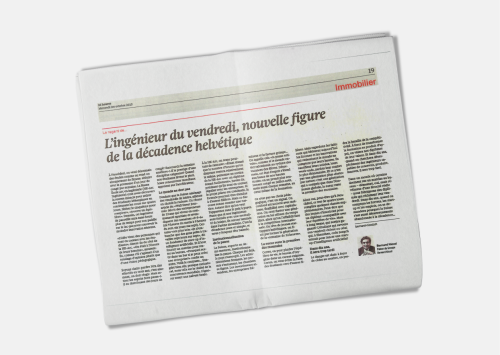
In an op-ed published in 24 heures, Bernard Nicod, founder of Groupe Bernard Nicod, warns against the "comfort culture" that is gaining ground in schools and impoverishing engineering training. At a time when the real economy is calling for solid skills to design high-performance buildings, reduce carbon footprints and deliver reliable worksites, he reminds us of an obvious fact that is all too often forgotten: Swiss quality is based on effort, rigor and the transmission of high standards.
An opinion piece that resonates far beyond the campus
The text points to a worrying development: the normalization of shortened weeks, "Fridays off" and, more broadly, schemes that promise a better life balance while reducing the density of learning. Far from denying the need for a healthy framework, Bernard Nicod insists on the misunderstanding: in initial training, flexibility is no substitute for mastery of the fundamentals. A diploma only has value if it attests to real skills and an ability to solve complex problems, not just to use ready-to-use tools.
The Friday engineer faced with the realities of the Swiss economy
In real estate as in industry, projects obey neither fashions nor shortcuts. Designing safe structures, orchestrating trades, complying with standards, guaranteeing a building's energy performance: all these require technical depth, resilience and a long view. Schools that make this clear continue to place their graduates in the best teams. On the other hand, lightweight teaching methods produce fragile profiles, less autonomous on construction sites and in design offices. It's not just a question of Swiss pride; it's the future of productivity, building quality and, ultimately, household purchasing power that's at stake.
Effort, competence and impact: what the market expects
The real estate market in French-speaking Switzerland is demanding. Investors demand sustainable, well-managed assets. Cities want low-energy neighborhoods that are pleasant to live in. Tenants expect comfort, controlled costs and reliable services. Between ideation and delivery, there are thousands of technical decisions to be made: choosing low-carbon materials, sizing systems, organizing logistics, monitoring risks and compliance. Without highly-trained engineers and project managers, these trade-offs deteriorate, deadlines are stretched, costs rise and energy performance is diluted. The effort made during design protects future users far more surely than a promise of ease.
A humanist position, not an apology for overload
Some people pit "requirement" against "well-being". This is a false dilemma. The aim is not to praise exhaustion, but to set a standard of mastery. Sustainable balance comes from responsible organizations: load management, clear expectations, tutoring, a pedagogical project connected to the field. This is exactly what Bernard Nicod is calling for: an ambitious training, connected to the business, that prepares for real responsibilities and useful innovation.
Our commitment at Groupe Bernard Nicod
For over thirty years, we've known that the value of a building lies in the skills of those who design and execute it. We therefore support courses of study that maintain a high academic standard, multiplying challenging internships, capstone projects linked to our operations and mentoring by practitioners. This bridge between school and worksite benefits everyone: students, industrial partners, local authorities and end customers.
Conclusion: exacting standards as a Swiss comparative advantage
Switzerland was built on precision and reliability. To give up on high standards today is to undermine the foundation of our competitiveness tomorrow. Bernard Nicod's column is not a regret for the past, it's a call to reinvest in the depth of knowledge to continue building sober, beautiful and sustainable cities. The "sweat" he invokes is not a posture: it's the currency that finances real innovation.