
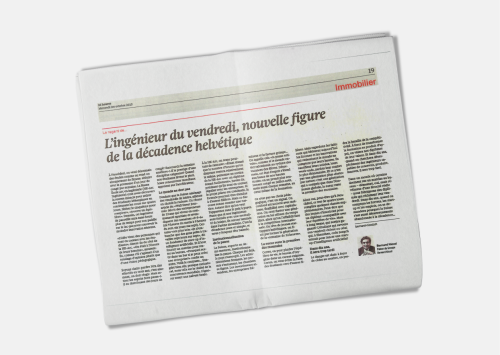
It's often said: "cheap is expensive". This proverb, well known in other areas of daily life, is also fully applicable to the real estate market. In his monthly column published in 24heures, Bernard Nicod, founder of the Group, reminds us why the savings promised by certain so-called "fixed-price" models can ultimately turn into substantial losses.
This spotlight highlights a strong conviction: selling real estate shouldn't be a simple accounting operation. It is above all a matter of strategy, expertise and trust, where the support of the right broker can make all the difference.
The deceptive promises of "fixed-price" models
In recent years, a number of so-called "package" real estate agencies have emerged in French-speaking Switzerland. Their promise is simple: to offer sellers a fixed fee, supposedly more advantageous than traditional commissions. But as is often the case, behind the marketing hype lie more nuanced realities.
Firstly, these packages don't always cover the full range of services. Additional visits, quality photo reports, videos, drones, promotion on specialized portals: these are just some of the services billed as extras, which can push up the bill by 30-50% over the advertised price.
Secondly, some of these agencies require a large, non-refundable deposit, even if the sale is unsuccessful. This practice transfers all the risk to the seller, whereas the role of a broker is precisely to accompany and secure the transaction.
Finally, advertised savings are often based on biased comparisons. Traditional brokers' commissions, generally between 2% and 2.5%, are much lower than the 3 to 5% claimed in the advertising campaigns of fixed-price agencies. In other words, the argument of a massive gain for the seller is far from always accurate.
When net seller price is the true measure
The example given by Bernard Nicod in his column is revealing.
Imagine the sale of an apartment for 900,000 francs by a fixed-price agency, charging 15,000 francs. The seller walks away with 885,000 francs.
By contrast, with a traditional broker, the same property can be valued and sold for 930,000 francs thanks to his network and experience. The 2.5% commission would amount to 23,250 francs. Net result for the seller: 906,750 francs. That's 21,750 francs more than with the package deal.
This example perfectly illustrates the difference between a purely pricing approach and a value approach. The traditional broker doesn't just carry out an assignment: he maximizes the property's potential and defends his customer's interests.
The entrepreneurial role of the traditional broker
Another often overlooked element is worth emphasizing: the traditional real estate broker is first and foremost an entrepreneur. He invests time, money and skills in each mandate, with no guarantee of remuneration.
Whether it's preparing a complete file, financing advertising campaigns or organizing dozens of visits, all this work is only remunerated if the sale is closed. This risk-taking naturally drives the broker to seek the best possible outcome, not the quickest.
In contrast, the flat-rate model, which is paid as soon as the contract is signed, does not have the same alignment of interests. Once the flat fee has been collected, the agency has already secured its income, regardless of the success of the sale.
Motivation, training and expertise : the real levers of performance
The difference isn't limited to the numbers. According to data published by Glassdoor, the average fixed-price agency broker earns between 48,000 and 60,000 francs a year. In a traditional agency, this income can reach between 85,000 and 127,000 francs a year. This difference reflects not only better recognition of the work, but also a higher level of qualification.
In fact, most traditional brokers hold a federal diploma as a broker, real estate appraiser or property manager. These often lengthy and demanding training courses guarantee a high degree of technical and legal competence.
The Bernard Nicod Group is actively engaged in this field with the BN Academy, an in-house program where junior brokers are trained and mentored by experienced senior brokers, to guarantee a continuous transmission of know-how, best practices and market knowledge.
The importance of personalized advice
Beyond the numbers and business models, a real estate sale is above all a human adventure. Selling an apartment, house or building often means turning an important page in your life. At such moments, the seller needs to be advised, accompanied and reassured.
The traditional broker offers personalized follow-up, from the first meeting to the final signature. He knows his customer, understands his expectations and adapts his strategy accordingly. This bond of trust is a key success factor, which impersonal, standardized models fail to recreate.
A clear conclusion: better to invest in quality
As Bernard Nicod sums up in his column: "Wanting to save money is all well and good. Real estate is a field where the added value of a competent professional is directly measured in financial results and peace of mind for the customer. Choosing the right partner means not only selling, but above all selling better.
Summary
- "Package" models promise savings, but often hide additional fees and risks for the seller.
- The traditional broker, paid only for success, seeks to maximize the sale price and acts in the customer's interest.
- His expertise, training and motivation offer real added value.
- With the BN Academy, the Bernard Nicod Group invests in the ongoing training of its employees to guarantee excellence and performance.
In real estate, as elsewhere, don't be seduced by price alone. Because in the end, the cheap stuff sometimes costs a lot more.
Are you thinking of buying or selling a property? Don't hesitate to contact one of our branches of the Bernard Nicod Group: our teams will be delighted to assist you with professionalism and proximity.